Quick answer: A mamak does not need to close for cockroach treatment. German cockroaches (Blattella germanica) in a 24-hour kitchen live inside the roti griddle base, the drink station and the chiller seals, so the fix is gel bait placed into those voids during the 3am–6am trough — not a fogging job. Expect a visible drop in 3 to 5 days and an established population cleared over a 3-visit intensive across 14 days, from RM490. See cockroach pest control →

Every pest control quote a mamak owner has ever read assumes the shop closes. Clear the premises, cover the food, fog it, come back in four hours. That advice is useless to a kitchen that serves supper until 3am and starts roti prep at 6am. The honest answer is that a mamak does not need to close at all — cockroach control in a 24-hour operation is gel bait placed into the equipment voids where Blattella germanica actually lives, worked station by station during your quietest window, with nothing sprayed across an open surface. What follows is how that is done in practice: where they hide in a mamak specifically, what a service night looks like, why the aerosol under your counter is making it worse, and what it costs.
Why do mamak kitchens get German cockroaches so badly?
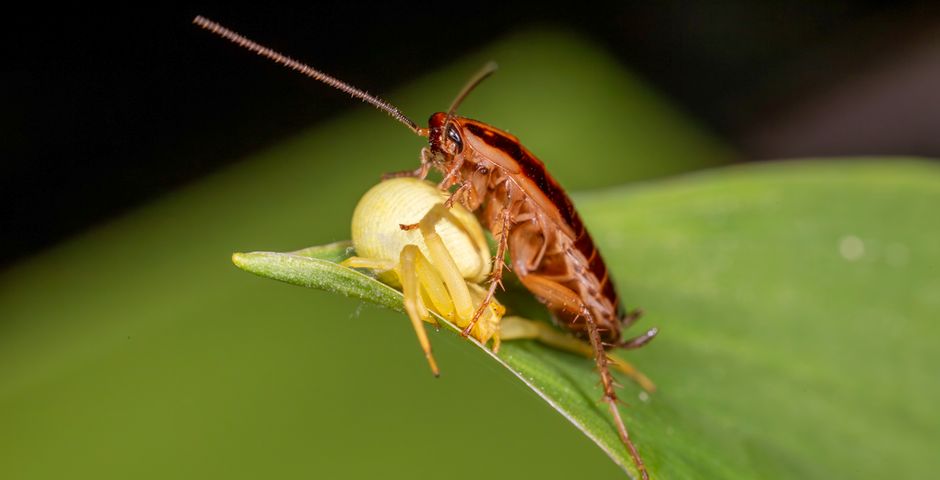
Two different cockroaches turn up in a mamak and they are not the same problem. The American cockroach (Periplaneta americana) is the big one that flies in from the drain at night. It comes from outside, it is unpleasant in front of customers, and it is comparatively easy to keep out. The German cockroach is smaller, pale brown, and it does not come from anywhere — it breeds indoors, inside your equipment, and it is the one that ends a licence renewal conversation early.
A mamak is close to ideal habitat for it. Warmth from equipment that runs 20 hours a day and never fully cools. Flour, ghee and sugar residue in a permanent thin film around the roti and prata station. Standing moisture at the wash area and the drink counter, which matters because a cockroach can go a month without food but only about a week without water. Cardboard arriving daily with the deliveries and sitting in the dry store, which is both transport and housing. And, more than anything, uptime — a shop with no closed period never gets pulled apart and deep cleaned, so the conditions reset to the same baseline every single day.
One female Blattella germanica carries an egg case with up to 40 eggs and produces several in her life, and in a warm kitchen a nymph reaches breeding age in about two months. That is why an infestation in a mamak does not creep. It steps.
The arithmetic nobody enjoys. One cockroach at the roti station at 2am is a sighting. If you can see three in daylight with the lights on, the harbourage is already full and they are being pushed out of it. You are not looking at the population. You are looking at the overflow.
Where do they actually hide in a mamak?

Almost never on the floor, and almost never where the cleaner has been told to look. In a mamak the survey list is consistent enough that we work it in the same order every time:
- The roti and prata griddle base. Warm, greasy, permanently in use, and with a motor housing or steel frame nobody has opened in years. This is the number one harbourage in a mamak and it is where the first bait goes.
- The drink and teh tarik station. Sugar syrup, condensed milk residue and condensation together. Look behind the counter framing and under the sink apron, not on the surface.
- Chiller and freezer door seals and motor compartments. The rubber gasket channel is a nursery, and the warm motor bay at the back is the winter quarters.
- The wall gap behind the burner bank or tandoor. The 20mm you cannot reach, at 35°C, next to a food source.
- The false ceiling above the cooking line. Greasy, undisturbed, and connected to the unit next door in most shoplots.
- Stacked cardboard in the dry store. Cartons are corrugated, which means they are pre-built harbourage delivered to your door for free.
- The floor drain and grease trap. The American cockroach route in, and where a rodent problem starts if it is going to.
A treatment that misses those seven does not fail because the chemical was weak. It fails because it was applied where the cockroaches were not.
“I rented an apartment beside waste chamber, for 2 years being spraying consistently but to no avail. But this service clear the root problem by give bait to main points around the house so that even the little ones baited.”
— Afiq Zamanhuri (Google review). A home rather than a kitchen, but it is exactly the mamak lesson. Two years of spraying the space you can see, against one round of bait placed where the population actually sits.
When do you treat a kitchen that never closes?
Between roughly 3am and 6am. Every mamak owner insists the shop never has a quiet moment, and every mamak has a trough — after the supper crowd thins and before the breakfast prep starts. It is short, and it is enough.
Three things make that window the right one. The cooking line can be worked station by station without a technician standing between a cook and the griddle. Equipment that runs all day can be pulled forward and opened up. And the drains, grease trap and bin area can be treated properly rather than skipped because service is on.
What does not need the window is the bait itself. Gel goes into cracks, hinges and equipment voids, not across open surfaces, so there is no fogging, no evacuation and no closure. Shops that would rather stay on a daytime slot can — it just means the technician gets less access to the line, and access is most of the job.
What happens on a service night?

- Walk the line first, treat second. Torch and mirror through the seven harbourage points above, plus a look at the monitors from last visit. What gets treated depends on what the monitors say, not on a fixed script.
- Station by station. One section at a time so the rest of the shop keeps running. Griddle, drink counter, chillers, prep bench, dry store, drains.
- Gel bait into the voids. BASF Provecta gel placed as small deposits inside hinges, frames, motor housings and cracks — the places a cloth never reaches. Food-safe, HACCP-certified products, Safety Data Sheets available on request.
- Non-toxic monitors, numbered. Placed at fixed points so the next visit can compare counts instead of relying on someone’s memory of how bad it looked.
- Drains and grease trap. Treated and, more usefully, reported on. A grease trap that is not on a cleaning schedule will undo everything else.
- Proofing notes. Mesh the floor drain, a door sweep on the back door, seal the pipe penetration behind the sink. Cheap, and it is what stops the American cockroaches walking back in.
- Dated service report. Products used, areas treated, activity trend, corrective actions for the operator. That is the document that goes in the licence file.
One thing to brief your staff on before the first visit: activity usually looks worse for the first few nights. Bait draws cockroaches out of harbourage before it collapses the population, and every kitchen that is not warned about this concludes at day three that the treatment made things worse. It didn’t. Expect a visible drop by day 5, and the bulk of an established population gone across a 3-visit intensive over 14 days.
A mamak in Ampang called us after failing an inspection and after two rounds of aerosol from a cheaper contractor who had worked the dining area at 10pm and never opened a single piece of equipment. The population was inside the prata griddle frame and the two chiller motor bays — nowhere the spray had ever reached. We baited both on the first 4am visit, meshed the floor drain, and got the owner to move the cardboard out of the dry store daily. Counts on the monitors dropped by roughly three quarters at the two-week check and the shop has been on monthly service since, with the report going straight into the licence file.
— Job notes, Nomobug field team
Why does spraying make it worse?
This is the hardest thing to convince a kitchen of, because spraying feels like doing something and bait looks like doing nothing.
Aerosol repels. Hit the edge of a harbourage with a supermarket can and the German cockroaches inside it do not die — they scatter, deeper into the equipment and further along the line, into voids that were previously clean. You get a quiet week because the survivors have moved, then a worse month because the population is now in four places instead of one. Spray also contaminates gel placements, so an enthusiastic staff member with a can undoes the one treatment that was reaching the ones nobody ever sees. And in a food premises it puts a chemical residue near food contact surfaces in return for nothing.
If you take one operational rule from this article: no aerosol in the kitchen, and tell the night shift, because that is who buys it. We cover the full mechanism in why cockroaches keep coming back after spraying.
What should staff fix between visits?
Roughly half the outcome in a 24-hour kitchen is housekeeping, and none of it is expensive:
- Break the griddle down on a rota. Not daily — nobody has time — but a scheduled strip and degrease of the base and frame, written on the cleaning roster with a name against it.
- Dry the drink station at shift change. Water is the limiting resource. Take it away and the population shrinks whether you treat or not.
- Cardboard out daily. Unpack, break down, remove. Never store cartons overnight.
- Bin out before the quiet shift, not in the morning. Overnight is when the bin area does its recruiting.
- Mesh and cap the floor drain. Around RM30. It closes the most common route in for both Periplaneta americana and rats.
- Grease trap on a written schedule. The single highest-value item on this list, and the one most often left to whoever remembers.
Staff turnover at a mamak is high, so put these on the wall rather than in a briefing. A rule that lives in one person’s head leaves when they do.
How much does it cost?
| Service | Typical market price | When it’s the right call |
|---|---|---|
| Single visit | RM320 | Recent, light activity in one area |
| 3-visit intensive over 14 days | RM540 | An established German cockroach population |
| Annual programme, premises under 2,000 sq ft | RM2,300 | Any shop trading 20+ hours a day |
| Larger premises or multiple outlets | Quoted by area and outlet count | Chains and centre operators |
For reference, Nomobug’s commercial pricing sits consistently around 10% below that typical market range — a single visit from RM290, the 3-visit intensive at RM490, and Annual Total Protection at RM2,090 a year for a premises below 2,000 sq ft. That last one is 15 visits (12 monthly plus 3 free), which works out to roughly RM139 a visit with documentation included. The full breakdown is in our commercial pest control price guide.
For a 24-hour kitchen the annual programme is usually the honest recommendation rather than the upsell. A mamak has no closed period, which means no deep clean, which means conditions reset daily — reactive treatment on a shop like that is buying the same 3-visit intensive twice a year and never getting ahead of it.



I’m giving him a 5-star rating.
Overall, from the last two visits, I found many spots/nests. The gel bait and Provcta were very impressive. The effect was very noticeable; the cockroaches were no longer visible in the kitchen. There were fewer in the living room. Today was my last visit for baiting and spraying. Hopefully, there will be no more cockroaches after this, God willing.
Highly recommended!



Nomobug has just completed their second service at my home, and once again I’m extremely impressed. They carried out contingency recurring control twice, especially targeting ants and cockroaches, and I really appreciate how they honor their warranty with such professionalism. The overall appointment scheduling and service management were smooth and reliable, which makes me feel very secure and well taken care of.
I’m very satisfied with the results and would highly recommend Nomobug to anyone looking for thorough pest control. Once my current contract finishes, I will definitely be renewing it.
It’s also worth highlighting that the same technician, Faris, has been consistently handling my house. He is punctual, polite, and highly professional. After completing the treatment, he provided a detailed report outlining his findings and preventive actions, even showing me examples of the control measures implemented. This level of transparency and care is rare, and I truly value it.
Overall, Nomobug continues to exceed my expectations—reliable, professional, and trustworthy.
4 MONTHS AGO:
I recently engaged Nomobug Servis Pest Control for a comprehensive treatment targeting cockroaches, ants, rats, common house geckos, and centipedes. They covered both the interior and exterior of my home—including my car—which was a huge plus.
The first service focused on prevention and control, and I was thoroughly impressed. The technician, Faris, was punctual, polite, and highly professional. He took the time to explain each step of the process—from inspection to recommending suitable control measures—and his work was exceptionally clean and tidy.
After completing the treatment, Faris provided a detailed report outlining his findings and the preventive actions taken and even showed me examples of the control measures implemented. I truly appreciated the transparency and care.
Overall, I’m very satisfied with their service and would confidently recommend Nomobug to anyone looking for reliable and thorough pest control.

Izzat handled it efficiently and professionally. Your quick response and technical skills really made the process smooth. Great teamwork and problem-solving!





Almost all places are sprayed.
Suggestions,
Hopefully the admin will send the same technician to work. Anyway, we are very satisfied with today’s service.
Thank you

We definitely add more services from them