Quick answer: Subterranean termites (Coptotermes) live in the soil, need moisture, and build mud tubes up to your timber — they’re the most common and destructive in Malaysia. Drywood termites (Cryptotermes) live inside the dry wood itself, need no soil, and leave small piles of dry, sand-like frass pellets under furniture and timber. Mud tubes and ground contact mean subterranean; gritty pellets with no tubes mean drywood. It matters because the treatment is completely different — one is dealt with at the soil, the other in the wood. See Nomobug’s termite treatment →

“Termites” isn’t one problem — it’s two very different ones, and confusing them wastes money on the wrong treatment. Here’s the short version: subterranean termites live in the soil and tunnel up into your house, while drywood termites live entirely inside the wood they’re eating — and because one has a soil colony and the other doesn’t, they’re treated in completely different ways. Get the species wrong and you can pour a soil barrier around a house whose problem is sitting in an antique cabinet. This guide covers how to tell them apart, which one you’re more likely to have in Malaysia, and what the right treatment looks like for each.
What’s the difference between the two?
Both are termites, both eat cellulose (wood), and both have a queen at the centre of the colony. The difference is where they live and how they reach their food — and everything else, including how you treat them, follows from that.
| Feature | Subterranean (Coptotermes) | Drywood (Cryptotermes) |
|---|---|---|
| Nest | In the soil, below ground | Inside the wood itself |
| Moisture | Needs high moisture / soil contact | Thrives in dry wood, no soil needed |
| Tell-tale sign | Mud tubes on walls / foundations | Piles of dry, sand-like frass pellets |
| Colony size | Very large — often millions | Small — hundreds to a few thousand |
| Usually found in | Ground-floor structure, skirting, foundations | Furniture, door/window frames, roof timber |
| Treatment | Baiting or soil barrier (at the soil) | Localized wood treatment / fumigation |
Subterranean termites: the common one
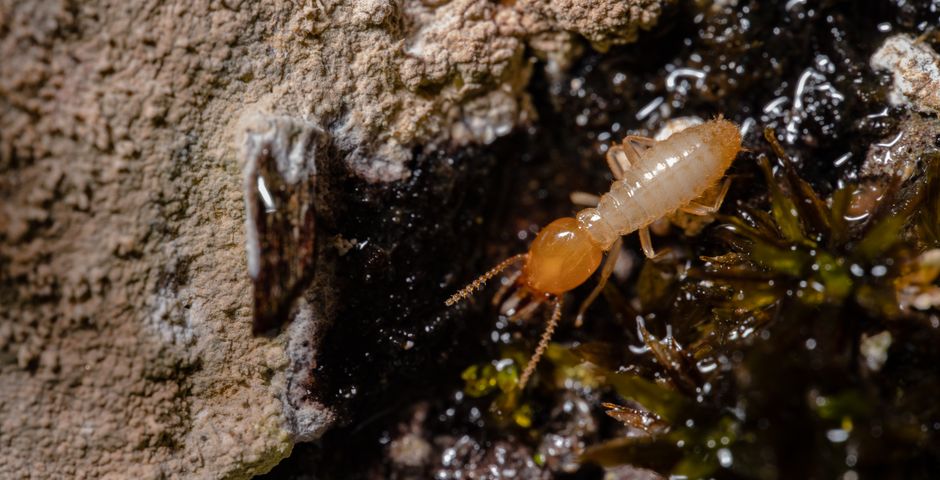
This is the termite the vast majority of Malaysian homeowners are dealing with. Coptotermes gestroi and the more aggressive Coptotermes curvignathus nest underground, where the warm, damp soil suits them, and their colonies grow into the millions. Because they need to keep moist, they can’t just walk across open ground and air — they build mud tubes, pencil-width tunnels of soil, to travel from the nest up into your skirting, door frames and structural timber.
They eat along the grain of the wood and leave soil and mud packed into their galleries, and they do it from the ground up. This is the termite behind almost all serious structural damage here, and because the colony is huge and hidden in the soil, it keeps coming until the colony itself is dealt with. The early signs — mud tubes, hollow timber, swarms after rain — are the ones we cover in what mud tubes on a wall mean and termite swarm season.
Drywood termites: the furniture one

Drywood termites (Cryptotermes) play a different game entirely. They live their whole lives inside a piece of wood — no soil, no mud tubes, almost no moisture required. A single piece of furniture, a door frame, a roof beam or a wooden fixture can host a colony that never touches the ground. That’s also how they spread into a home in the first place: often by hitchhiking in a piece of infested second-hand or imported timber that gets carried straight through your front door.
Their signature sign is frass — dry fecal pellets, gritty like coarse sand or coffee grounds, that the termites push out of tiny “kick-out” holes to keep their galleries clean. You’ll find little piles of it on the floor directly below the infested wood, on a shelf, or on a window sill. No mud tubes, no soil, just the neat pellet piles and, if you tap the wood, a hollow sound. Colonies are far smaller than subterranean ones, so the damage is slower and more localized — but hidden inside a beam, it can still get advanced before you spot the pellets.
A homeowner in Ampang was sure she had a termite emergency — little piles of “sawdust” kept appearing under an old teak cabinet she’d bought second-hand. It wasn’t the subterranean job she feared and it wasn’t in her walls at all: drywood termites living inside that one piece. We treated the cabinet directly instead of the house. Right species, right treatment, a fraction of the cost she’d braced for.
— Job notes, Nomobug field team
How do you tell which one you have?
You can usually narrow it down yourself before anyone visits — it comes down to three questions.
- Are there mud tubes? Pencil-width mud tunnels on a wall, foundation or skirting mean subterranean. Drywood termites never build them.
- Is there dry, sandy frass? Small piles of gritty pellets under furniture or timber, with no mud and no soil, mean drywood.
- Where is it, and is there ground contact? A problem low down, near the soil, in the ground-floor structure leans subterranean. A problem up high — a roof beam, an upstairs frame — or inside a standalone piece of furniture leans drywood.
When it’s genuinely unclear, don’t guess — a clear photo of the frass or the tubes is all a technician needs to name the species, and getting that right is the whole point. It’s the same “confirm before you commit” logic as our guide to checking a house for termites before you buy.
Why the treatment is completely different

This is why naming the species first isn’t fussy — it changes the entire job.
Subterranean termites are treated at the soil, because that’s where the colony is. If they’re active in your home, Nomobug recommends baiting — stations placed on the active trails so the colony carries the bait back and collapses, queen included. If the goal is prevention on a new build or a clear home, a soil barrier keeps them out. Either way, you’re dealing with the ground.
Drywood termites have no soil colony to reach, so soil methods do nothing. Treatment is localized to the affected wood: drilling and injecting termiticide into the infested timber, spot treatment of the piece, or simply replacing a badly eaten item of furniture. For a rare whole-structure drywood infestation, fumigation (tenting) is the option that reaches every gallery at once. The right choice depends on how far it has spread — which is exactly what an inspection establishes.
Pour a soil treatment around a house whose only problem is a drywood colony in one cabinet and you’ve spent thousands treating the wrong thing. Bait the soil for a drywood colony in the roof and nothing happens. The species decides the method — full stop. Costs for the subterranean options are in our termite treatment cost guide.
Related reading
- White ants vs termites — clearing up what people mistake for termites.
- What mud tubes on a wall mean — the classic subterranean sign, read properly.
- Termite baiting vs soil treatment — how subterranean colonies are dealt with.
- Nomobug termite treatment — inspection first, then the right treatment for the species.
References
- Forest Research Institute Malaysia (FRIM) — termite species identification and biology — frim.gov.my
- Jabatan Pertanian Malaysia (Department of Agriculture) — registered termiticide database — doa.gov.my



I’m giving him a 5-star rating.
Overall, from the last two visits, I found many spots/nests. The gel bait and Provcta were very impressive. The effect was very noticeable; the cockroaches were no longer visible in the kitchen. There were fewer in the living room. Today was my last visit for baiting and spraying. Hopefully, there will be no more cockroaches after this, God willing.
Highly recommended!



Nomobug has just completed their second service at my home, and once again I’m extremely impressed. They carried out contingency recurring control twice, especially targeting ants and cockroaches, and I really appreciate how they honor their warranty with such professionalism. The overall appointment scheduling and service management were smooth and reliable, which makes me feel very secure and well taken care of.
I’m very satisfied with the results and would highly recommend Nomobug to anyone looking for thorough pest control. Once my current contract finishes, I will definitely be renewing it.
It’s also worth highlighting that the same technician, Faris, has been consistently handling my house. He is punctual, polite, and highly professional. After completing the treatment, he provided a detailed report outlining his findings and preventive actions, even showing me examples of the control measures implemented. This level of transparency and care is rare, and I truly value it.
Overall, Nomobug continues to exceed my expectations—reliable, professional, and trustworthy.
4 MONTHS AGO:
I recently engaged Nomobug Servis Pest Control for a comprehensive treatment targeting cockroaches, ants, rats, common house geckos, and centipedes. They covered both the interior and exterior of my home—including my car—which was a huge plus.
The first service focused on prevention and control, and I was thoroughly impressed. The technician, Faris, was punctual, polite, and highly professional. He took the time to explain each step of the process—from inspection to recommending suitable control measures—and his work was exceptionally clean and tidy.
After completing the treatment, Faris provided a detailed report outlining his findings and the preventive actions taken and even showed me examples of the control measures implemented. I truly appreciated the transparency and care.
Overall, I’m very satisfied with their service and would confidently recommend Nomobug to anyone looking for reliable and thorough pest control.

Izzat handled it efficiently and professionally. Your quick response and technical skills really made the process smooth. Great teamwork and problem-solving!





Almost all places are sprayed.
Suggestions,
Hopefully the admin will send the same technician to work. Anyway, we are very satisfied with today’s service.
Thank you

We definitely add more services from them