You’ve seen a small rodent dart across the kitchen and now you’re trying to work out what it was. Here’s the honest answer most pages won’t lead with: in a Malaysian home it’s almost certainly a rat, not a mouse. True house mice (Mus musculus) are uncommon here — the small “mouse” people see is usually a young rat or the Asian house rat (Rattus tanezumi), which stays small even when fully grown. The difference still matters, because it changes how you treat it. This is the practical ID guide.
The Short Answer for Malaysian Homes
In temperate countries, the house mouse is the default indoor rodent. In Malaysia, it isn’t. Our homes are rat country — the Asian house rat, the roof rat, and the Norway rat do the overwhelming majority of the damage, and the classic little house mouse is comparatively rare.
That’s why so many people get this wrong. They see something small and grey, think “tikus kecil, probably a mouse,” and buy a mouse trap. But a small rat is still a rat: it breeds faster than a mouse, it’s warier of traps, and it carries a heavier health load. Calling it the right thing from the start saves you a fortnight of a trap sitting there doing nothing.
Rats vs Mice: The Visual ID Guide

The single most useful trick: a mouse looks too small for its ears, while a rat looks too chunky for its ears. Once you’ve seen that, you rarely get it wrong. Here’s the full side-by-side.
| Feature | House mouse | Rat (incl. Asian house rat) |
|---|---|---|
| Body length | 7–10 cm | 16–25 cm (plus tail) |
| Ears | Large for the head | Smaller against a chunky head |
| Snout | Pointed, delicate | Blunt, heavier |
| Tail | Thin, hairy, longer than body | Thick, scaly, around body length |
| Feet | Small | Noticeably large, even on young rats |
| Droppings | ~5 mm, rice-grain, pointed ends | 12–18 mm, capsule-shaped, blunt ends |
| Behaviour | Curious, investigates new objects | Cautious, avoids new objects at first |
The trap that catches people out is the young rat. It’s mouse-sized, so it gets misidentified constantly. The tell is proportion: a young rat has a noticeably bigger head and feet relative to its body than a real mouse ever does. If the feet look too big for the animal, it’s a juvenile rat.
The Three Rats (and the One Mouse) You Might Have
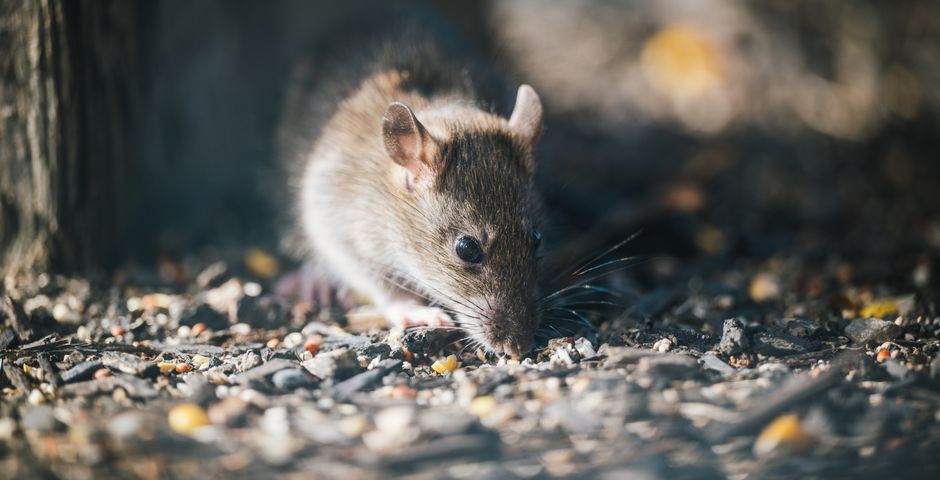
Knowing the species tells you where to look and how to treat. Four matter in Malaysia.
- Asian house rat (Rattus tanezumi). The small, very common indoor rat that most Malaysian homeowners actually have — and the one most often mistaken for a mouse. It moves through living spaces, kitchens, and storerooms.
- Roof rat (Rattus rattus). The slim climber that lives up high — ceiling voids, roof beams, the tops of tall cabinets. That thumping you hear at night is usually this one. More on that in how to tell if it’s rats in your ceiling.
- Norway rat (Rattus norvegicus). The big brown ground-dweller that comes up from drains, back lanes, and ground-floor voids. Stockier and lower down than the other two.
- House mouse (Mus musculus). The genuine article — tiny, big-eared, curious. Present in Malaysia but far less common than the rats. If you truly have a mouse, it’s nesting in a warm, hidden spot like a wall cavity or behind an appliance.
Rats turn up everywhere, but they’re most stubborn in older housing and industrial-fringe areas with plenty of drains and back lanes — we see a lot of callouts in Klang and Puchong. Same species, same playbook, just more entry points to chase.
Why the Difference Changes the Treatment

This is where getting the ID right pays off. Mice and rats don’t respond to the same approach.
Mice are curious and roam only a short distance from the nest — often just a few metres. They nibble at many food sources a little at a time. So mouse control uses more bait points, spaced closely together, and a curious mouse will usually investigate a new trap within a day or two.
Rats are the opposite. They have neophobia — a genuine wariness of anything new in their environment — so a freshly placed trap or station often gets avoided for several days. The fix is pre-baiting: you leave the trap unset, or the station stocked but non-lethal, until the rats accept it as part of the furniture, then switch it live. Stations go along established runs — wall edges, beams, drain lines — not out in the open. Rush this and you’ll swear the bait “doesn’t work,” when really the rat just hasn’t trusted it yet.
One thing is identical for both: sealing entry points is what actually keeps them out. Baiting clears the current rodents; if the gaps around pipes, the broken roof tiles, and the uncapped drain holes stay open, a new one moves into the empty territory within weeks. We covered the usual routes in the rat entry points most people miss.
A terrace house in Klang had thumping in the ceiling for weeks and the owner had set two mouse traps that never went off. It was roof rats, not mice — wrong trap, wrong placement, out in the open where wary rats wouldn’t go. We pre-baited along the beams for three days, switched live, and cleared them in under a week. The real win was capping an open drain hole behind the kitchen cabinet that was letting new ones in.
— Job notes, Nomobug field team
Reading the Signs: Droppings, Gnaw Marks, Gaps
You’ll usually find the evidence before you see the animal. The signs also tell you which rodent you’re dealing with.
Droppings are the fastest tell. Rice-grain sized (about 5mm) with pointed ends means mouse. Capsule-shaped and 12–18mm with blunt ends means rat. Fresh droppings are dark and soft; old ones are grey and crumble. A scatter of fresh rat-sized droppings along one wall edge is an active run, not a one-off visitor.
- Gnaw marks. Mice leave small, clean scratch holes about the size of a 10 sen coin. Rats leave larger, rougher holes with visible tooth gouges, and they chew through tougher material — including electrical wiring.
- Smear marks. Rats follow the same routes and leave greasy dark smudges along skirting and beams where their oily fur rubs. Mice leave fainter marks.
- The gap test. A mouse fits through about a 6mm gap — roughly a pen’s width. A rat needs 12–20mm but will gnaw a small gap wider. If you can fit a biro through a hole, a mouse can use it.
- Sound. Scratching and thumping from the ceiling at night points to roof rats. Ground-level scuttling in the kitchen at night is more likely the Asian house rat.
Rats carry the bigger health concern of the two: they can spread leptospirosis, which the Ministry of Health tracks as a notifiable disease, and rodent-gnawed wiring is flagged by the Fire and Rescue Department as a recurring contributor to house fires. That’s the real reason not to leave it for months.
When You Can Handle It — and When to Call
We’re not going to tell you to book a service for a single rodent. Save your money if:
- You caught one in a snap trap, there are no droppings piling up, and you’ve had no repeat sightings. Seal the gap it came through and watch for two weeks.
- You found a single entry gap and closed it, and the activity stopped. One rodent is not a colony.
- It’s a genuine one-off after heavy rain pushed something indoors — common, and often self-resolving once the weather settles.
Call a professional when the signs point to an established group rather than a stray: ongoing droppings, thumping in the ceiling, gnawed wiring, smear marks along the walls, or more than one or two sightings. At that point the job isn’t “catch the rat,” it’s “find every entry point, treat correctly for the species, and seal it out.” That’s where guessing rat-versus-mouse stops being good enough.



I’m giving him a 5-star rating.
Overall, from the last two visits, I found many spots/nests. The gel bait and Provcta were very impressive. The effect was very noticeable; the cockroaches were no longer visible in the kitchen. There were fewer in the living room. Today was my last visit for baiting and spraying. Hopefully, there will be no more cockroaches after this, God willing.
Highly recommended!



Nomobug has just completed their second service at my home, and once again I’m extremely impressed. They carried out contingency recurring control twice, especially targeting ants and cockroaches, and I really appreciate how they honor their warranty with such professionalism. The overall appointment scheduling and service management were smooth and reliable, which makes me feel very secure and well taken care of.
I’m very satisfied with the results and would highly recommend Nomobug to anyone looking for thorough pest control. Once my current contract finishes, I will definitely be renewing it.
It’s also worth highlighting that the same technician, Faris, has been consistently handling my house. He is punctual, polite, and highly professional. After completing the treatment, he provided a detailed report outlining his findings and preventive actions, even showing me examples of the control measures implemented. This level of transparency and care is rare, and I truly value it.
Overall, Nomobug continues to exceed my expectations—reliable, professional, and trustworthy.
4 MONTHS AGO:
I recently engaged Nomobug Servis Pest Control for a comprehensive treatment targeting cockroaches, ants, rats, common house geckos, and centipedes. They covered both the interior and exterior of my home—including my car—which was a huge plus.
The first service focused on prevention and control, and I was thoroughly impressed. The technician, Faris, was punctual, polite, and highly professional. He took the time to explain each step of the process—from inspection to recommending suitable control measures—and his work was exceptionally clean and tidy.
After completing the treatment, Faris provided a detailed report outlining his findings and the preventive actions taken and even showed me examples of the control measures implemented. I truly appreciated the transparency and care.
Overall, I’m very satisfied with their service and would confidently recommend Nomobug to anyone looking for reliable and thorough pest control.

Izzat handled it efficiently and professionally. Your quick response and technical skills really made the process smooth. Great teamwork and problem-solving!





Almost all places are sprayed.
Suggestions,
Hopefully the admin will send the same technician to work. Anyway, we are very satisfied with today’s service.
Thank you

We definitely add more services from them