Quick answer: For a Malaysian home, choose soil treatment if you don’t have termites yet and want to prevent them — new builds, pre-construction, or an existing home you want to protect with a long-term barrier — accepting some drilling, with a 3 to 5 year warranty. Choose termite baiting if you already have an active termite problem, because it eliminates the colony feeding on your home without drilling finished tiling, over the 6 to 8 weeks it typically takes. Both target subterranean termites (Coptotermes gestroi and curvignathus); Nomobug offers both and matches the method to your infestation stage. See Nomobug’s termite treatment →

You’ve found termites, you’ve called around, and now you’re stuck on the same question everyone gets stuck on: bait stations or soil treatment? Here’s the honest version before the detail: soil treatment builds a chemical barrier that protects the structure straight away but usually needs drilling, while baiting quietly eliminates the entire colony in a matter of weeks with almost no disruption — and neither is simply “better,” it depends on your floors, your timeline, and how far the termites have got. This is the head-to-head: how each one actually works, what it costs in Malaysia, and a plain decision guide at the end.
What’s the real difference?
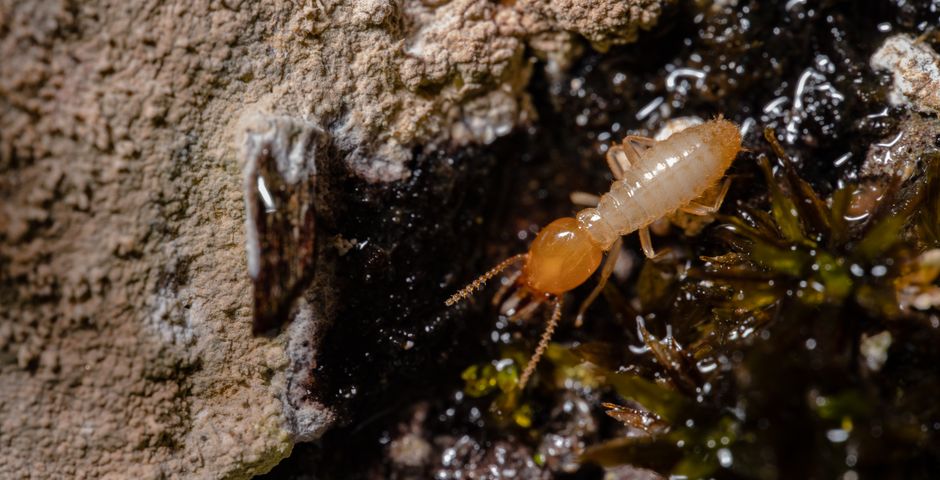
Both methods target the same enemy — the underground (subterranean) termite that travels through soil and mud tubes to reach the timber in your home. In Malaysia that’s almost always Coptotermes gestroi or the more aggressive Coptotermes curvignathus. Where they differ is the strategy.
Soil treatment defends the building. It puts a termiticide barrier in the ground so the structure becomes hostile territory — termites that try to cross it are killed. The colony out in the garden may still be alive; it just can’t get in.
Baiting attacks the colony. It uses the termites’ own foraging against them: they find the bait, eat it, share it, and the colony collapses from the inside — queen included. There’s no barrier; the point is that after a few months there’s no colony left to build one.
That single distinction — protect the structure now versus eliminate the colony over time — drives every other trade-off below.
How does soil (liquid) treatment work?

Soil treatment — also called a liquid barrier or soil poisoning — floods the soil around and under the building with a termiticide, usually a non-repellent one like fipronil. Non-repellent matters: the termites can’t detect it, so they walk through, pick up a lethal dose, and pass it to nest-mates before they die.
On a house that’s already built, that means work. The technician digs a shallow trench around the perimeter and drills a line of small holes through concrete aprons, porches and along internal walls so the chemical can reach the soil beneath the slab. The holes get patched afterward. It’s thorough, and it’s a bit invasive — there’s no way to treat the soil under a finished floor without getting to it.
The payoff is speed and a warranty. The barrier is protecting the structure the moment it’s laid, and a soil treatment typically carries a 3-year warranty (5 years for a heavier application). For a new build or a renovation, the same chemical laid before the flooring goes down — pre-construction soil treatment — is cheaper and completely non-disruptive, because the slab isn’t there yet.
How does termite baiting work?
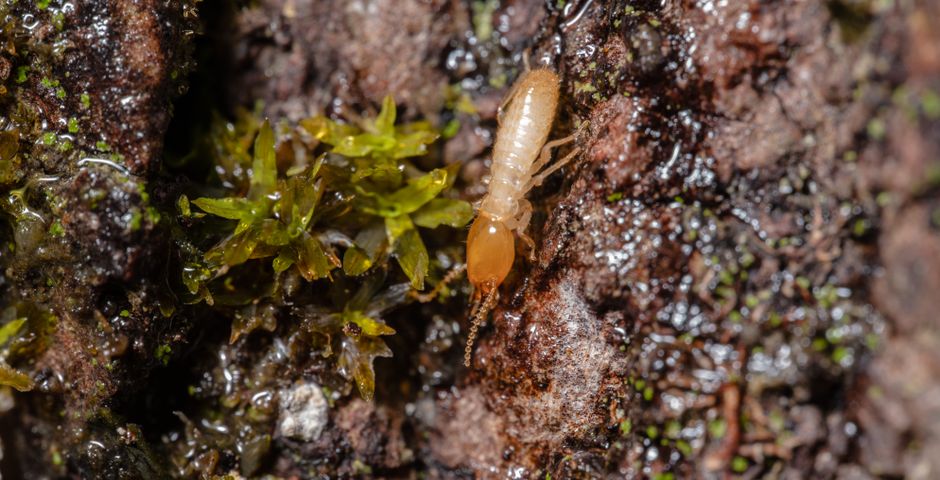
Baiting works with the biology instead of against it. The technician places baiting stations — housings holding cellulose (the wood the termites want) laced with a slow-acting growth inhibitor such as chlorfluazuron — directly on the active termite trails and mud tubes, usually inside the house where the termites are already feeding. The idea is simple: give them bait to eat so they stop chewing your cabinets, skirting and other timber. Foraging workers feed on it and carry it back to share through the colony by trophallaxis, the mouth-to-mouth food sharing termites do.
The active ingredient stops termites from moulting. Since termites have to shed their exoskeleton to grow, the colony can’t replace its workers, its numbers crash, and eventually the whole colony — including the queen it can no longer feed — dies out. Termite baiting is the popular post-construction remedial method across Southeast Asia for exactly this reason: it reaches the colony a barrier never touches.
Two honest points. First, it’s not instant — the technician checks and tops up the bait every 2 weeks while the growth inhibitor works through the colony, so full elimination typically takes about 6 to 8 weeks here. Second, because the stations sit right on the active trails, the termites feed straight away, which is part of why it clears faster than in-ground systems. Nomobug runs the system until the whole colony is destroyed and backs it with a 1-year warranty — not a rolling annual subscription.
“Habis rosak perabot dekat rumah. Servis pest control anai anai (termites) delivered by Nomobug. Terima kasih.”
— Jihan Muse, actress. By the time the furniture was already ruined, the argument for treating early — with whichever method fits — makes itself.
Speed, disruption and colony kill compared

Put side by side, the trade-offs are clear. Neither wins on every row — which is the whole point.
| Factor | Soil (liquid) treatment | Termite baiting |
|---|---|---|
| Speed of protection | Immediate barrier | About 6 to 8 weeks to colony death |
| Kills the colony? | Protects structure; may not eliminate colony | Yes — queen included |
| Disruption | Trenching + drilling through floors | Minimal — stations on the trails, no drilling |
| Chemical used | Larger volume of liquid termiticide | Very small amount of bait matrix |
| Best for | Prevention — new builds, pre-construction, no termites yet | Active infestations — colony already in the home |
| Warranty | 3 to 5 years | 1 year, run until the colony is gone |
The “may not eliminate the colony” line for soil treatment is the one people miss. A barrier is brilliant at keeping termites out, but if the colony next door stays healthy it keeps sending scouts to probe for a gap — and barriers can be breached by later building work or gaps in the soil. Baiting removes that pressure at the source. That’s the genuine trade for its slower pace.
How much does each cost in Malaysia?
Termite work is priced per property, not off a flat menu — the size of the building, the length of the perimeter and the severity of the infestation all move the number. These are rough market ranges for a terrace house in the Klang Valley:
| Treatment | What it covers | Typical market price |
|---|---|---|
| Soil treatment (3-yr) | Preventive barrier for an existing home, 3-year warranty | from around RM3,960 |
| Soil treatment (5-yr) | Heavier preventive application, 5-year warranty | from around RM4,950 |
| Termite baiting system | On-trail stations, 1-yr warranty, run until colony gone | from around RM3,080 |
| Pre-construction soil treatment | New build, before the floor goes down | from around RM1,320 |



I’m giving him a 5-star rating.
Overall, from the last two visits, I found many spots/nests. The gel bait and Provcta were very impressive. The effect was very noticeable; the cockroaches were no longer visible in the kitchen. There were fewer in the living room. Today was my last visit for baiting and spraying. Hopefully, there will be no more cockroaches after this, God willing.
Highly recommended!



Nomobug has just completed their second service at my home, and once again I’m extremely impressed. They carried out contingency recurring control twice, especially targeting ants and cockroaches, and I really appreciate how they honor their warranty with such professionalism. The overall appointment scheduling and service management were smooth and reliable, which makes me feel very secure and well taken care of.
I’m very satisfied with the results and would highly recommend Nomobug to anyone looking for thorough pest control. Once my current contract finishes, I will definitely be renewing it.
It’s also worth highlighting that the same technician, Faris, has been consistently handling my house. He is punctual, polite, and highly professional. After completing the treatment, he provided a detailed report outlining his findings and preventive actions, even showing me examples of the control measures implemented. This level of transparency and care is rare, and I truly value it.
Overall, Nomobug continues to exceed my expectations—reliable, professional, and trustworthy.
4 MONTHS AGO:
I recently engaged Nomobug Servis Pest Control for a comprehensive treatment targeting cockroaches, ants, rats, common house geckos, and centipedes. They covered both the interior and exterior of my home—including my car—which was a huge plus.
The first service focused on prevention and control, and I was thoroughly impressed. The technician, Faris, was punctual, polite, and highly professional. He took the time to explain each step of the process—from inspection to recommending suitable control measures—and his work was exceptionally clean and tidy.
After completing the treatment, Faris provided a detailed report outlining his findings and the preventive actions taken and even showed me examples of the control measures implemented. I truly appreciated the transparency and care.
Overall, I’m very satisfied with their service and would confidently recommend Nomobug to anyone looking for reliable and thorough pest control.

Izzat handled it efficiently and professionally. Your quick response and technical skills really made the process smooth. Great teamwork and problem-solving!





Almost all places are sprayed.
Suggestions,
Hopefully the admin will send the same technician to work. Anyway, we are very satisfied with today’s service.
Thank you

We definitely add more services from them